


By opting in you agree to receive emails from us and our affiliates. Your information is secure and your privacy is protected.
Investing
29-01-2026 11:51
1 Views
Can the India-EU trade deal put India-US talks into fast gear?
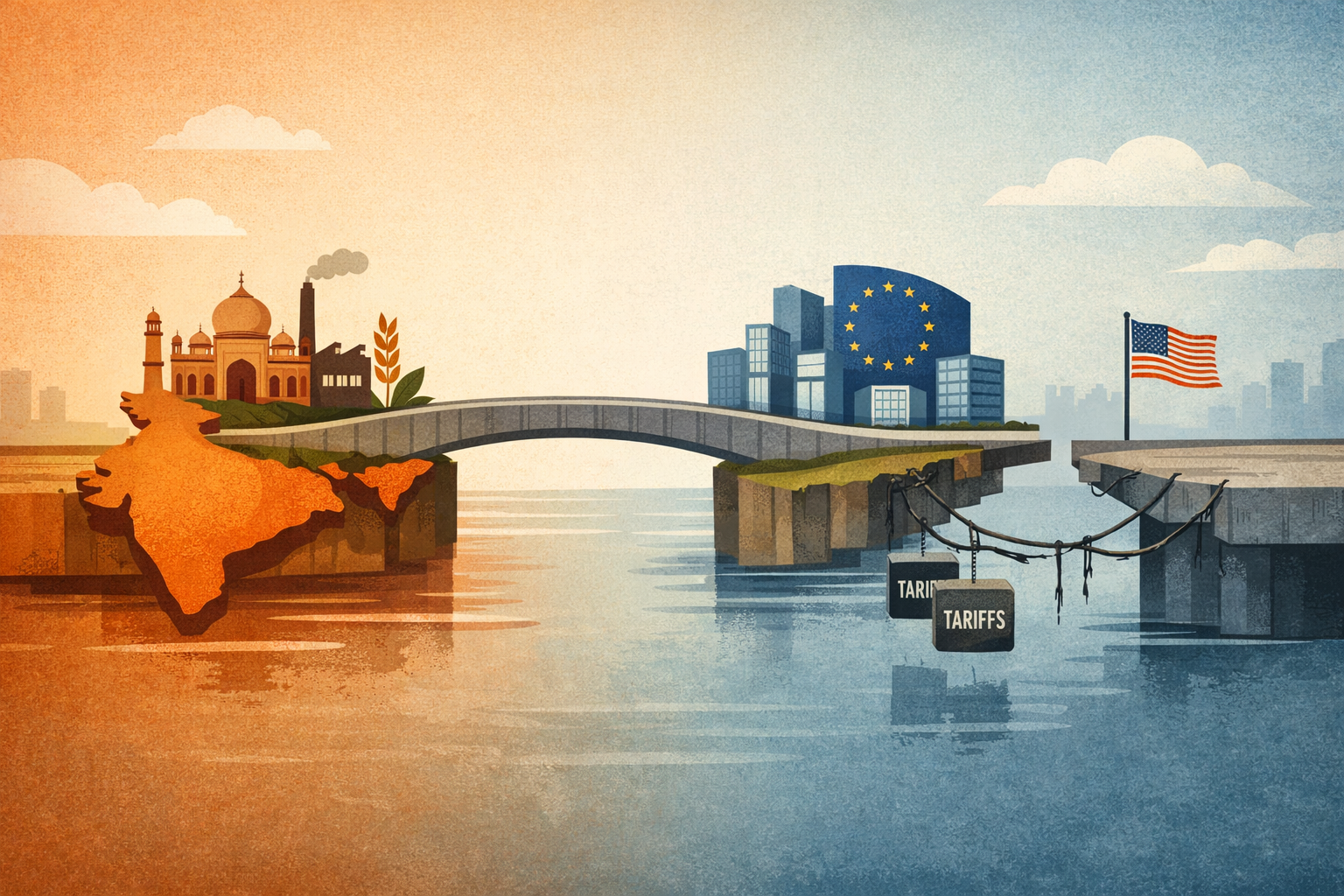
India and the European Union signed a long-awaited free trade agreement on Tuesday, billed by officials as the “mother of all deals”, prompting renewed scrutiny of how — or whether — the pact alters Washington’s approach to its own stalled trade negotiations with New Delhi.
The timing of the landmark trade deal, nearly two decades in the making, has been flagged by experts as especially significant.
It comes as India, a long-term US ally, has been hit with merciless tariffs from Washington — 50% on goods imported from India, including 25% in “punitive tariffs” for continuing to buy oil from Russia.
Additionally, in recent days, Trump threatened to impose 10% tariffs on European allies for standing up to him over his planned takeover of Greenland.
Although he later retracted the threat in Davos and said the tariffs were “suspended,” the episode left long-time allies across the Atlantic even more uneasy than before.
Why the India-EU trade deal begs a US question
The aforementioned reasons, experts say, have caused “accelerated” talks between India and the EU in the last few months, with the announcement of the deal capping those talks.
However, more importantly, the US also finds a mention in commentary about the EU–India trade deal, as the country is pursuing its own trade agreement with India, which has been mired in several delays, with multiple informal deadlines having been missed and no clarity whatsoever on when it will materialise.
Against this backdrop, observers were on the lookout for what Trump might have to say after the deal was signed on Tuesday amid much pomp and show.
However, no commentary was forthcoming.
US Treasury Secretary Scott Bessent, however, did attack the India–EU free trade agreement.
Speaking to ABC News, Bessent defended the Trump administration’s decision to slap steep tariffs on Indian goods, linking them directly to India’s energy trade with Moscow.
“We have put 25 per cent tariffs on India for buying Russian oil. Guess what happened last week? The Europeans signed a trade deal with India,” he said.
Bessent pointed out that the Russian oil that goes into India is used to make refined products that are then bought by Europeans, which means “they are financing the war against themselves”.
Between Washington’s tactlessness, Brussels’ pragmatism and Indian agriculture
“Washington is certainly not likely to view this (the deal) very kindly, because the US has been desperately trying to open up markets using force rather than diplomacy, and it has really not succeeded,” Biswajit Dhar, trade economist and former professor at the Jawaharlal Nehru University (JNU) in India, told Invezz.
Dhar added that Trump did not respect the sensitivities of any country, especially India, which has a complex economy, making it impossible to accept some of the conditions that Trump tried to impose.
We all know that agriculture is really the sticking point. Now, contrast that with what the EU did. It also had interests in agriculture in the beginning and wanted market access in agricultural products, but realpolitik really prevailed over everything else, and they allowed India to not offer tariff cuts on agriculture, which is how the whole thing went through..
According to reports, across multiple rounds of trade talks, Indian negotiators have consistently maintained that protecting the farm sector is a non-negotiable priority.
The entry of cheaper imports from countries like the United States — where farms are larger, mechanised and heavily subsidised — could destabilise domestic crop prices and put smaller landholders at significant risk, with 86% of India’s farmers operating on small and marginal holdings of less than two hectares.
India has not included major agricultural commodities in any free trade agreement negotiated thus far.
Can the EU–India trade deal add urgency to US–India trade talks?
There is a mixed bag of expert opinion on whether, with major global powers aligning among themselves while the US is viewed warily, the country would accelerate talks to conclude the India–US BTA.
“The EU–India deal could even light a fire under efforts to conclude a US–India trade deal and help to move negotiations forward on a comprehensive bilateral trade agreement, as US President Donald Trump and Indian Prime Minister Narendra Modi discussed last year,” said Mark Linscott, Atlantic Council nonresident senior fellow on India.
Linscott, however, maintains that while the India–EU agreement may be interpreted as a response to the Trump administration’s tariffs and tariff threats, “there is no reason it should undermine the US trade relationships with either the EU or India”.
Hardeep Singh Puri, India’s minister for petroleum and natural gas, told CNBC on Tuesday that the India–US trade deal was at a “very advanced stage”, even as he admitted he did not know when it would be concluded.
“I’m told by the people who are in it [the negotiations] that it’s at a very advanced stage, and I’m hoping that, sooner rather than later, it will also see the light of day,” he added of the US deal.
Citi analysts said on Wednesday that markets would be “keenly watching immediate repercussions” of the EU–India deal on India–US tariff talks.
There would be hope that those negotiations might be fast-tracked now, though it remains to be seen whether Indian authorities would be in a better position to withstand the higher US tariffs, given the easier access to the large EU market.
However, Dhar seeks to highlight that mere optics might not provide the US with enough fuel to hasten the talks, as the problem lies elsewhere.
Dhar says that by making “exaggerated promises” to his constituencies during the 2024 presidential elections — especially farm lobbies — of opening up the Indian market for US produce, Trump has effectively “boxed himself into a corner”.
“He really can’t move away from his campaign promise.”
In the 2024 presidential election, almost 78% of farming-dependent counties supported Trump, and Dhar has earlier written that US farm lobbies representing corn, soybean and wheat interests have also been strongly lobbying the US government for access to the Indian market.
“So, in terms of negotiating with India, agreeing to allow it to maintain higher tariffs on agriculture and deciding to revisit it at a later stage is not possible given the kind of dynamics that he himself has set in motion. So I don’t see how the situation is going to change,” he said.
The post Can the India-EU trade deal put India-US talks into fast gear? appeared first on Invezz
Other news